All Primary Antibodies
Primary antibodies, immunoglobulins that bind to specific proteins or other biomolecules, are used in many research applications and protocols to detect targets of interest. They are developed using different animal hosts, including mouse, rat, rabbit, goat, sheep, and many others.
Monoclonal and Polyclonal Antibodies
One type of primary antibodies, monoclonal antibodies, provides high reproducibility and low cross-reactivity and background noise. Another type, polyclonal antibodies, often costs less and provides greater affinity and quicker binding. Both are produced using plasma B cells, but the former uses the same clone and the latter uses different clones. Monoclonal antibodies require hybridoma cell lines, and polyclonal antibodies do not.
There are also recombinant monoclonal antibodies with similar benefits, like high affinity, scalability, and specificity. They are produced using in vitro cloning of plasma B cells and expression hosts.
Conjugated Primary Antibodies
Antibodies can be labeled with various fluorophores or detection agents or used without labels. Labeled primary antibodies, also known as conjugated primary antibodies, help researchers simplify and streamline their applications. They are coupled with common enzymes and dyes such as Alexa Fluor and often used in protein and cell analysis.
Applications
Antibodies for life sciences applications are used in flow cytometry, western blotting, ELISA, immunohistochemistry, and immunocytochemistry. Secondary antibodies can be added to support the detection and purification of certain antigens. They bind to the primary antibody, which binds to the antigen of interest. Finding the right combination of antibodies can result in greater antigen specificity and a strong, detectable signal.
- (2)
- (7)
- (32)
- (5)
- (2)
- (4)
- (5)
- (2)
- (12)
- (13)
- (2)
- (75)
- (40)
- (44)
- (2)
- (2)
- (2)
- (2)
- (2)
- (2)
- (2)
- (2)
- (2)
- (2)
- (2)
- (2)
- (2)
- (2)
- (2)
- (2)
- (2)
- (2)
- (2)
- (2)
- (2)
- (2)
- (2)
- (2)
- (2)
- (31)
- (1)
- (1)
- (1)
- (41)
- (43)
- (56)
- (2)
- (13)
- (6)
- (1)
- (2)
- (1)
- (2)
- (1)
Risultati della ricerca filtrata
Invitrogen™ EXOSC3 Polyclonal Antibody
Greener Choice Product
This product offers one or more environmental benefits itemized in the U.S. FTC Green Guides.
Learn More About the Greener Choice Program
This product offers one or more environmental benefits itemized in the U.S. FTC Green Guides.
Learn More About the Greener Choice Program
Rabbit Polyclonal Antibody
Invitrogen™ EXOSC3 Polyclonal Antibody
Greener Choice Product
This product offers one or more environmental benefits itemized in the U.S. FTC Green Guides.
Learn More About the Greener Choice Program
This product offers one or more environmental benefits itemized in the U.S. FTC Green Guides.
Learn More About the Greener Choice Program
Rabbit Polyclonal Antibody
Invitrogen™ EXOSC3 Polyclonal Antibody
Greener Choice Product
This product offers one or more environmental benefits itemized in the U.S. FTC Green Guides.
Learn More About the Greener Choice Program
This product offers one or more environmental benefits itemized in the U.S. FTC Green Guides.
Learn More About the Greener Choice Program
Rabbit Polyclonal Antibody
Invitrogen™ EXOSC3 Polyclonal Antibody
Greener Choice Product
This product offers one or more environmental benefits itemized in the U.S. FTC Green Guides.
Learn More About the Greener Choice Program
This product offers one or more environmental benefits itemized in the U.S. FTC Green Guides.
Learn More About the Greener Choice Program
Rabbit Polyclonal Antibody
Invitrogen™ EXOSC3 Polyclonal Antibody
Greener Choice Product
This product offers one or more environmental benefits itemized in the U.S. FTC Green Guides.
Learn More About the Greener Choice Program
This product offers one or more environmental benefits itemized in the U.S. FTC Green Guides.
Learn More About the Greener Choice Program
Rabbit Polyclonal Antibody
| ID gene (immissione) | 51010 |
|---|---|
| Specie ospite | Rabbit |
| Immunogeno | This antibody was developed against Recombinant Protein corresponding to amino acids: VYWVDSQQKRYVPVKGDHVIGIVTAKSGDIFKVDVGGSEPASLSYLSFEGATKRNRPNVQVGDLIYGQFVVANKD |
| Target Species | Human |
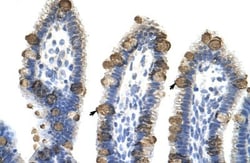
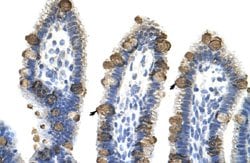
| Applicazioni | Western Blot,Immunohistochemistry,Immunocytochemistry/Immunofluorescence,Immunohistochemistry (Paraffin) |
| Coniugato | Unconjugated |
| Classificazione | Polyclonal |
| Alias gene | bA3J10.7, CGI-102, exosome complex exonuclease RRP40, exosome component 3MGC15120, exosome component Rrp40, hRrp-40, hRrp40p, p10Rrp40p, Ribosomal RNA-processing protein 40, RP11-3J10.8, RRP40MGC723 |
| Isotype | IgG |
| Forma | Purified |
| Antigene | EXOSC3 |
| Metodo di purificazione | Immunogen affinity purified |
| Status giuridico | RUO |
| Formulazione | PBS (pH 7.2) and 40% Glycerol |
| Disciplina di ricerca | DNA replication Transcription Translation and Splicing |
| Diluizione | Western Blot 0.04-0.4 μg/mL, Immunohistochemistry 1:50 - 1:200, Immunocytochemistry/Immunofluorescence 0.25-2 μg/mL, Immunohistochemistry-Paraffin 1:50-1:200 |
| Primario o secondario | Primary |
| ID gene (immissione) | 51010 |
|---|---|
| Specie ospite | Rabbit |
| Content And Storage | Store at -20°C. Avoid freeze-thaw cycles. |
| Immunogeno | Recombinant fusion protein containing a sequence corresponding to amino acids 1-275 of human EXOSC3 (NP_057126.2).,, Sequence:, MAEPASVAAESLAGSRARAARTVLGQVVLPGEELLLPEQEDAEGPGGAVERPLSLNARACSRVRVVCGPGLRRCGDRLLVTKCGRLRHKEPGSGSGGGVYWVDSQQKRYVPVKGDHVIGIVTAKSGDIFKVDVGGSEPASLSYLSFEGATKRNRPNVQVGDLIYGQFVVANKDMEPEMVCIDSCGRANGMGVIGQDGLLFKVTLGLIRKLLAPDCEIIQEVGKLYPLEIVFGMNGRIWVKAKTIQQTLILANILEACEHMTSDQRKQIFSRLAES |
| Target Species | Human,Mouse,Rat |
| Applicazioni | ELISA,Western Blot |
| Coniugato | Unconjugated |
| Classificazione | Polyclonal |
| Alias gene | bA3J10.7, CGI-102, exosome complex exonuclease RRP40, exosome component 3MGC15120, exosome component Rrp40, hRrp-40, hRrp40p, p10Rrp40p, Ribosomal RNA-processing protein 40, RP11-3J10.8, RRP40MGC723 |
| Isotype | IgG |
| Forma | Purified |
| Antigene | EXOSC3 |
| Metodo di purificazione | Affinity purified |
| Status giuridico | RUO |
| Formulazione | PBS (pH 7.3), 50% glycerol |
| Disciplina di ricerca | DNA replication Transcription Translation and Splicing |
| Diluizione | Western Blot 1:500 - 1:2000, ELISA |
| Primario o secondario | Primary |
| ID gene (immissione) | 313243, 51010, 66362 |
|---|---|
| Specie ospite | Rabbit |
| Content And Storage | -20°C |
| Immunogeno | EXOSC3 Fusion Protein Ag7065 |
| N. accesso geni | Q7TQK4, Q9NQT5 |
| Target Species | Human,Mouse,Rat |
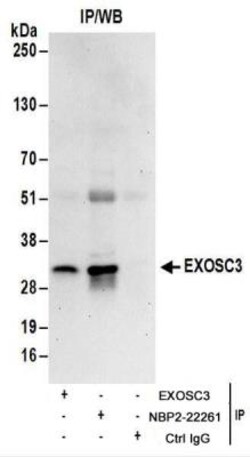
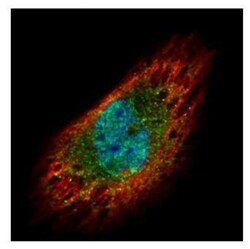
| Applicazioni | Immunocytochemistry,Immunofluorescence,Immunohistochemistry (Paraffin),Immunoprecipitation,Western Blot |
| Coniugato | Unconjugated |
| Classificazione | Polyclonal |
| Alias gene | CGI 102, EXOSC3, exosome component 3, hRrp 40, hRrp40p, p10, RP11 3J10.8, RRP40, Rrp40p |
| Isotype | IgG |
| Forma | Liquid |
| Antigene | EXOSC3 |
| Gene | EXOSC3 |
| Product Type | Antibody |
| Metodo di purificazione | Antigen Affinity Chromatography |
| Simboli geni | Exosc3 |
| Status giuridico | RUO |
| Formulazione | PBS with 50% glycerol and 0.02% sodium azide; pH 7.3 |
| Concentrazione | 0.19 mg/mL |
| Primario o secondario | Primary |